$ git status → nothing hidden
Everything is a file.
API Craft is a desktop API IDE where specs, requests, environments, workflows and docs are plain files in your git repo. Edit them in the app, from the craftr CLI, or in vim. Same files, three interfaces. No account. No cloud sync. No lock-in.
Public builds open shortly. Free tier, no signup. Windows coming.
{ "version": 1, "name": "Find available pets", "operation": { "resource": "Pet", "name": "findByStatus" }, "params": { "query": { "status": "available" } }}A real project. Click a file: what you see is what's on disk, and what the GUI edits.
why
The difference isn't a feature. It's the model.
| Postman | Bruno | API Craft | |
|---|---|---|---|
| Where your work lives | Their servers | Your repo | Your repo |
| Account | Required to keep anything | None | None |
| Format | Proprietary; export to leave | .bru files | JSON, YAML, Markdown, OpenAPI |
| What's modeled | A folder of requests | A folder of requests | Resources and operations, from the spec |
| The OpenAPI spec | Imported once | Imported once | The source of truth |
| A request is | One mutable object | One file | N instances per operation |
| Working with someone | Per seat, per month | git | git |
Bruno got the file layer right, and got it right first. API Craft goes one layer up.
instances
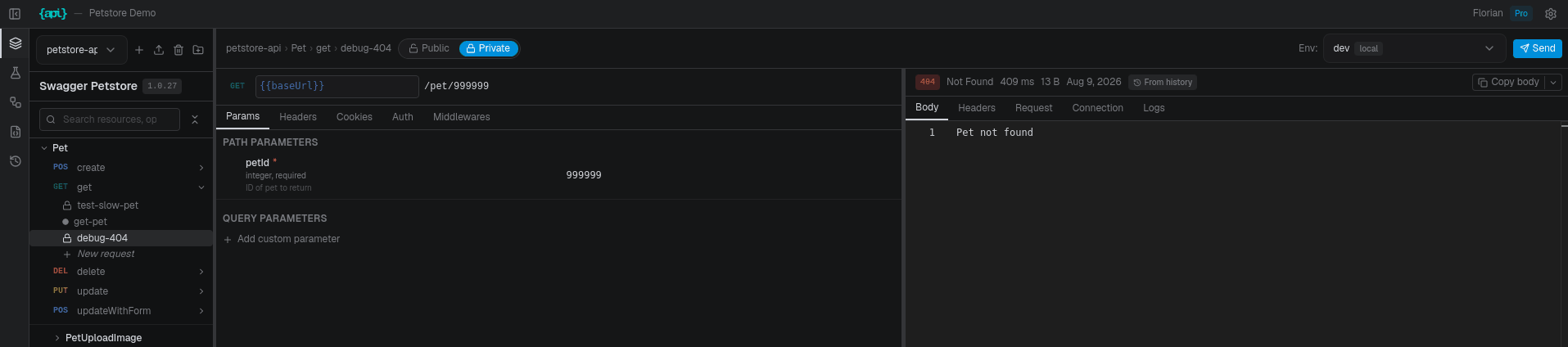
A request is a file, not a slot you overwrite.
Everywhere else a request is a single mutable object, so to try something you overwrite the thing you're trying it on. Here an operation comes from the spec and each request instance is a file under it. Keep as many as you want: shared with the team, personal, or scratch.
environments
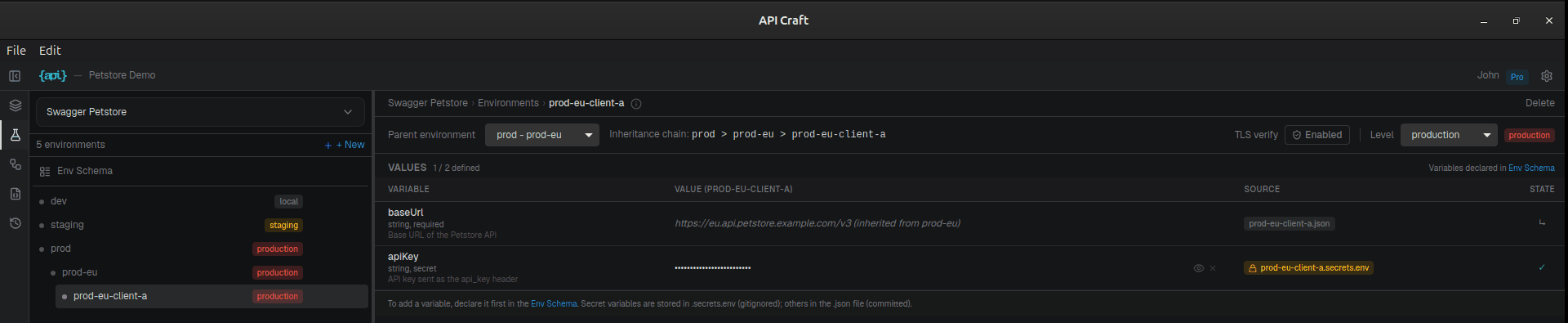
Environments inherit. Secrets never leave your machine.
Variables are declared once in a schema: typed, required or optional, secret or not. Values live in committed JSON per environment; secrets live next to them in gitignored dotenv files. The extends chain resolves recursively, with cycle detection.
workflows
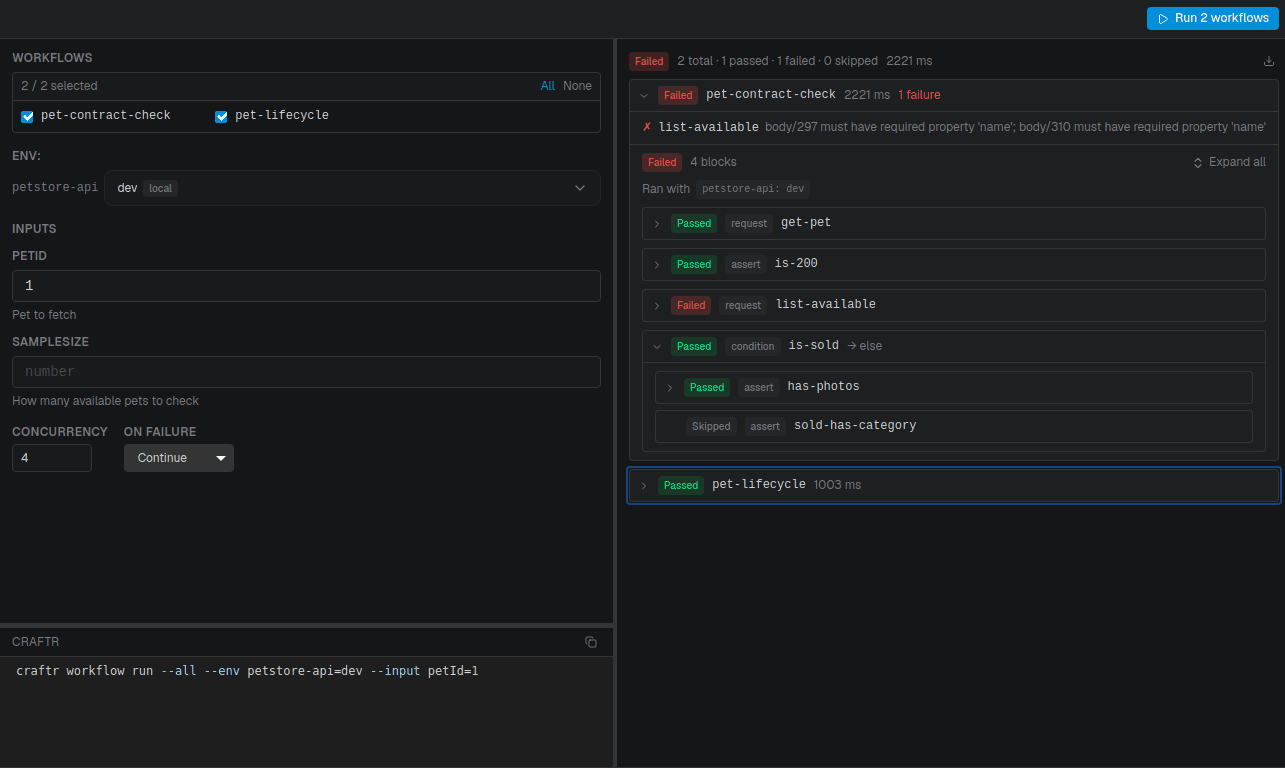
API tests as state machines. In JSON, in your repo.
A workflow is a sequence of typed blocks (request, assert, condition, loop) with declarative assertions for the common cases and TypeScript when you need real logic. Author it in the app; run the same file headless with craftr workflow run in CI.
cli
The GUI authors. The CLI runs anywhere.
$ craftr req run Pet/find-by-status \
    --api petstore-api --env dev --full | jq '.response.status'
200
$ craftr workflow run pet-lifecycle --env petstore-api=staging
{ "status": "passed", "total": 1, "passed": 1, "failed": 0 }
JSON output, always. Colored on a TTY, raw when piped, so jq works with no extra flags.
# .github/workflows/api-tests.yml
steps:
  - uses: actions/checkout@v4
  - run: npm install -g @apicrafthq/cli
  - run: craftr workflow run pet-lifecycle --env petstore-api=staging
    env:
      API_CRAFT_VAR_APIKEY: ${{ secrets.PETSTORE_KEY }}
The repo is the collection. CI needs checkout, one install, one command.
agents
Your agent already knows how to use it.
Every project is JSON, YAML and Markdown on disk, and the CLI prints JSON for everything the app can do. So Claude Code, Cursor, or any coding agent works with the tools it already has: read the API model, write a request instance, run it, read the result, fix itself. No plugin, no integration, no API key.
> add a request for sold pets and check it works

  Bash   craftr schema read -a petstore-api
         → Pet: get, create, delete, update…
  Write  apis/petstore-api/resources/Pet/
           requests/find-sold.json
  Bash   craftr req run Pet/find-sold
           --env dev
         → {"status": 200, "body": [ … ]}

Added find-sold. Returns 200 with 4 pets.
pricing
Free to live in. Paid when it becomes structural.
Free
$0
1 API per project, unlimited projects. 2 environments, 3 workflows. Full CLI, full GUI. No account, no wall.
Pro soon
$49· one-year license
Everything unlimited. One payment, no subscription. Offline license file, verified locally.
Team soon
—
Shared secrets, run dashboards, docs hosting. Leave an email to hear about it.